
Accuracy, Precision, and Resolution
Accuracy, precision, and resolution are fundamental concepts in measurement and metrology.
Accuracy, precision, and resolution are fundamental concepts in measurement and metrology. Each describes different aspects of measurement quality and reliability. Understanding these concepts is essential for assessing the performance of measurement instruments and methods and accurately interpreting measurement data.
Accuracy
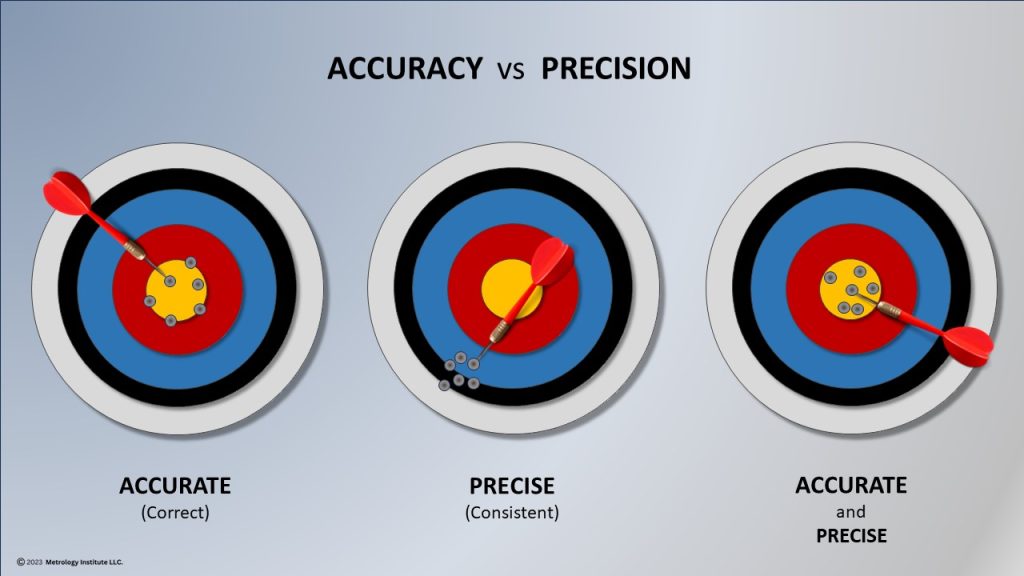
Instrument accuracy refers to the closeness of a measured value to a standard or known value (often referred to as the “true” value). It is an indication of the measurement error, representing the discrepancy between the measured value and the true value.
Accuracy is critical for ensuring that measurements are correct and reliable. It is essential in applications where measurements must closely reflect the actual measurement properties, such as quality control, medical diagnostics, and scientific research. High accuracy often requires calibration against known standards and correction for systematic errors.
Precision
Measurement precision relates to the repeatability or reproducibility of measurements, i.e., how close the measurements are to each other under unchanged conditions. It does not necessarily imply closeness to the true value, as a series of measurements can be precise (very close to each other) but not accurate (far from the true value).
Precision is essential in applications where measurement consistency is critical, even if the measurements are slightly off from the true value. High precision is vital in manufacturing processes, quality testing, and any scenario where measurement variations could lead to significant differences in outcomes or interpretations.
Resolution
Resolution is the slightest change in a measured quantity that an instrument can detect. The instrument’s design or the measurement method’s inherent limitations often determine it.
Resolution affects the level of detail that is discerned from measurements. High resolution is critical in fields requiring acceptable discrimination between closely spaced measurement values, such as spectroscopy, microscopy, and precision engineering. An instrument’s resolution limits the slightest difference that can be reliably measured, impacting its suitability for specific applications.
For example, if the true value for the temperature is 25°C, and a thermometer reads 26°C, it is not accurate. However, if the thermometer consistently reads 26°C every time it is used, then it is precise but not accurate. On the other hand, if the thermometer reads 25.5°C, it is accurate and precise.
Accuracy |
Precision |
Accurate & Precise |
|
The measurement is correct—the closeness of a given measurement to its true value |
The stability of the measurement, when repeated multiple times, is consistent with other measurements. |
The measurement is correct and consistent with other measurements. |
The Importance of Accuracy, Precision and Resolution in Measurement
While accuracy, precision, and resolution are distinct concepts, they are interrelated, and all contribute to the quality of measurements. High precision and resolution are desirable but must be accompanied by high accuracy to ensure that measurements are consistent, detailed, and correct.
Together, these concepts determine the reliability and usefulness of measurement data. In practice, achieving an optimal balance among accuracy, precision, and resolution—given cost, time, and technology constraints—is a critical challenge in measurement science. This balance ensures that measurements meet the requirements for specific applications, supporting informed decision-making, quality control, and scientific discovery.

Accuracy, precision, and resolution each play a crucial role in the quality and reliability of measurements. Understanding these concepts helps design measurement systems, choose the appropriate instruments, and interpret measurement data effectively.