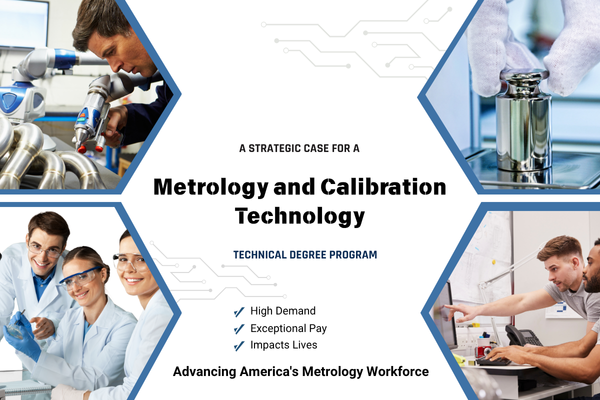
Advancing America’s Metrology Workforce
Advancing America’s Metrology Workforce is not optional—it’s essential. The calibration technician is the invisible hero behind every safe flight, clean surgical tool, accurate diagnostic test, and defect-free microchip. To remain a global innovation and manufacturing leader, we must invest now in the people who ensure our measurements are precise, our standards are upheld, and our future is competitive.
America’s global competitiveness in high-technology industries depends on its ability to measure with precision. The calibration technician plays a vital yet often overlooked role, from artificial intelligence to missile guidance systems, semiconductors to life-saving medical devices. These professionals ensure accuracy, traceability, and safety in systems and processes essential to our economy and national security.
Yet across the country, employers report a critical shortage of skilled calibration professionals. This workforce gap threatens to stall innovation, erode safety standards, and jeopardize compliance in industries that form the backbone of the U.S. economy. It is time to make metrology—the science of measurement- a national workforce priority.
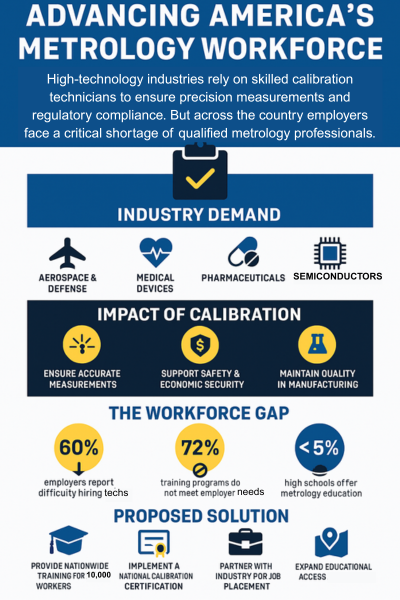
1. The Strategic Importance of Metrology
Calibration Technicians: Guardians of Accuracy
Calibration technicians are trained specialists responsible for the precise measurement and adjustment of equipment and instrumentation. Their work is foundational to:
- Ensuring aircraft safety in aerospace
- Validating production systems in semiconductor fabs
- Meeting FDA and ISO standards in medical devices and pharmaceuticals
- Guaranteeing the reliability of clean energy systems and AI sensors
Industries at Stake
The following sectors rely heavily on high-precision calibration:
- Aerospace & Defense: Navigation, avionics, missile systems
- Medical Devices & Healthcare: MRI machines, infusion pumps, diagnostics
- Pharmaceutical Manufacturing: Sterility assurance, process validation
- Semiconductors: Nanometer-scale fabrication, cleanroom compliance
- Energy: Nuclear, renewables, smart grid sensors
Without a robust metrology workforce, the ability to innovate, produce, and protect is fundamentally compromised.
2. The Workforce Gap: A National Vulnerability
What the Data Shows
- 60% of advanced manufacturers cite a shortage of qualified calibration technicians (National Skills Coalition, 2023)
- 72% of employers report that current training programs are inadequate, fragmented, or outdated
- Fewer than 5% of U.S. high schools offer any instruction in measurement science
- Minority, rural, and veteran communities are underrepresented in metrology pathways
This gap is especially urgent given accelerating demands from:
- Artificial Intelligence and robotics
- Clean energy expansion
- National defense modernization
- Medical advancement in Healthcare
- ISO 17025 compliance requirements
- FDA /cGMP regulatory compliance
3. Why Calibration Matters Now More Than Ever
Calibration is not just a technical process—it’s a national priority:
- Economic Security: Inaccurate measurements lead to costly recalls, defects, and inefficiencies
- Public Safety: Lives depend on the precision of devices in healthcare and aerospace
- Cyber-Physical Systems: AI and robotics require perfectly aligned sensors and feedback systems
- Energy Independence: From hydrogen infrastructure to nuclear energy, measurements dictate performance
The U.S. must ensure a next-generation metrology workforce capable of operating at the speed of innovation.
4. Proposed Solution: A National Metrology Workforce Initiative
Vision:
Training, credentialing, and deploying 10,000 metrology professionals by 2030 to support national competitiveness and compliance in high-technology sectors.
Key Components:
- Curriculum Modernization: NIST-aligned, modular training in dimensional, pressure, temperature, electrical, and chemical calibration
- Mobile Labs & Regional Hubs: Hands-on calibration training delivered through mobile units and community college centers
- Workforce Partnerships: Collaboration with employers in aerospace, pharma, semiconductors, and clean energy
- Credentialing & Apprenticeships: National Calibration Technician Certification (CTC) + Department of Labor-registered pathways
- Equity in Access: Focus on rural schools, veterans, and underrepresented populations
5. The Need for a National Calibration Technician Certification
A Critical Industry Requirement for Competence, Consistency, and Compliance
The Role is Technically Demanding
Calibration technicians must:
- Interpret tight tolerances and equipment specifications
- Perform precise adjustments and record traceable results
- Operate within regulatory frameworks: ISO/IEC 17025, AS9100, CFR Part 11
A Skills & Standards Gap
- 61% of employers say applicants lack basic knowledge
- 74% support national certification for assurance
- 82% lack standard evaluation methods for calibration roles
Existing Training is Inconsistent
- Limited program availability
- Outdated or theory-heavy content
- Lack of hands-on or employer-validated outcomes
Certification Framework
Calibration Technician Certification (CTC):
- Level 1: Core metrology measurement principles
- Level 2: Metrology discipline & equipment-specific calibration
- Level 3: Uncertainty budgets, systems-level audits
Credentialing Mechanism:
- Theory exam + performance-based practical’s
- Valid for 3–5 years
- Integrate into apprenticeships and community college programs
Benefits to Stakeholders
- Employers: Hire-ready talent, lower onboarding costs, compliance assurance
- Workers: Recognized credentials, upward mobility, wage premiums
- Educators: Clear outcomes, credentialed pathways
- National Economy: Workforce resilience, innovation capacity, economic mobility
6. Policy Recommendations
Federal & State Government
- Establish and fund a National Metrology Workforce Program via NIST, DoL, and DoEd
- Offer tax incentives and grant support for employer-sponsored training
- Embed calibration and measurement science into STEM and CTE frameworks
Industry
- Co-develop and endorse national standards
- Support apprenticeships and internship pipelines
- Fund mobile labs and training delivery
Education
- Adopt NIST-aligned curricula and certifications
- Provide dual-credit and modular learning models
- Invest in faculty development for metrology instruction
7. Conclusion
Advancing America’s Metrology Workforce is a call to action. The calibration technician is the unseen cornerstone of every advanced process, from healthcare and aerospace to clean energy and semiconductor production. This white paper outlines a roadmap to ensure the U.S. can train, certify, and scale a metrology workforce capable of meeting the challenges of tomorrow.
In today’s data-driven, precision-reliant world, measurements must be right the first time, every time. A national Calibration Technician Certification will raise the floor of competence, improve economic productivity, and ensure America remains a trusted leader in high-stakes innovation.
The future of American innovation, security, and economic strength rests on our ability to measure accurately and train those who make that precision possible.