

What is a Metrologist?
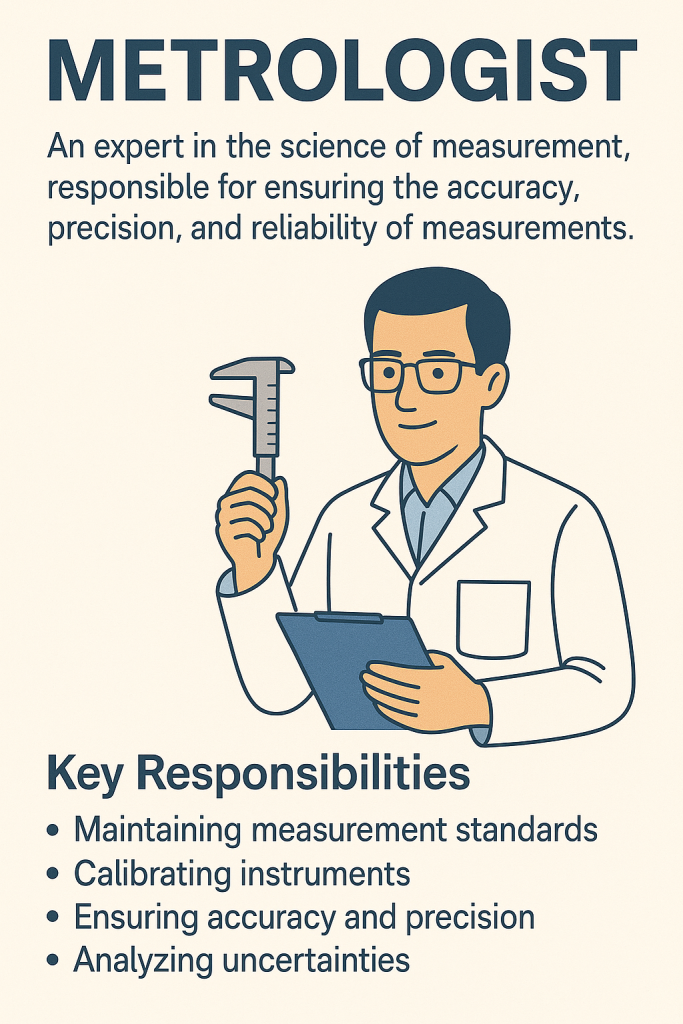
A Metrologist is a qualified, skilled technical professional engaged in the science of measurement (metrology). The role involves developing, implementing, calibrating, and verifying measurement systems to ensure traceability, accuracy, and compliance with applicable standards and regulatory requirements. Metrologists apply scientific and engineering principles to establish and maintain measurement accuracy across various domains, including dimensional, electrical, thermal, mechanical, and chemical measurements.
Application Areas
Metrologists operate in, supporting sectors such as aerospace, manufacturing, medical devices, energy, pharmaceuticals, and consumer protection.
Key Responsibilities
- Develop and maintain measurement standards traceable to national or international references (e.g., NIST, SI units).
- Calibrate instruments such as micrometers, pressure gauges, or torque wrenches to ensure they perform within specified tolerances.
- Conduct uncertainty analysis and ensure measurements are both repeatable and reliable.
- Support quality assurance systems by verifying that measurements comply with regulatory, safety, and industry standards (e.g., ISO/IEC 17025).
- Design measurement methods for new products, processes, or technologies in sectors such as aerospace, semiconductors, pharmaceuticals, or energy.
Types of Metrologists
- Scientific Metrologists – Work in national laboratories and focus on advancing measurement science.
- Industrial Metrologists – Ensure manufacturing measurements meet design and regulatory specifications.
- Legal Metrologists – Oversee measurements used in trade and consumer protection (e.g., fuel dispensers, weighing scales).
Importance
Metrologists play a vital role in ensuring product quality, safety, innovation, and global trade compatibility. Their work underpins technological progress and regulatory compliance in industries where precision is critical.