

TRACEABILITY
Traceability in measurement is a crucial concept that links the accuracy and consistency of measurements across different locations and over time.
Traceability involves establishing an unbroken chain of comparisons to national or international standards. Traceability is crucial in many fields, including manufacturing, science, and engineering, as it ensures the reliability of measurements and, thus, the quality and safety of products and processes. It also facilitates international trade, as measurements traceable to common standards are universally recognized, removing technical barriers.
Key Elements of Traceability
Standards and References: Traceability requires that all measurements be traced back to appropriate, universally recognized standards. These standards could be primary standards held by national metrology institutes (such as NIST in the United States or PTB in Germany) or international standards maintained by global organizations.
Unbroken Chain of Comparisons: Traceability involves a hierarchy of measurements. At each level, there is a known relationship to the level above (nearer to the standard) or below. This unbroken chain of comparisons ensures that each measurement can be linked to a recognized standard through a documented process.
Calibration: Instruments used for measurements are calibrated against reference materials or instruments that are themselves traceable to a standard. Calibration corrects and compensates for any deviations in measurement instruments, ensuring their accuracy.
Documentation: Each step in the measurement chain must be documented. This documentation includes details about the measurement process, the instruments used, calibration certificates, and the traceability chain itself. This allows for the reproduction and verification of results.
Uncertainty: Each measurement carries an uncertainty, which must also be traceable. The uncertainty quantifies the confidence in the measurement’s accuracy and is critical for making informed decisions based on the measurement results.
Standards of Measurement
Standards of measurement are established benchmarks used to ensure the accuracy, consistency, uniformity, and reliability of measurements across various fields, including science, industry, and commerce. These standards define the precise values of units of measurement, enabling uniformity and comparability of measurements worldwide. The concept of measurement standards and their role in ensuring measurement uniformity is foundational to the field of metrology, the science of measurement.
Concept of Measurement Standards
Measurement standards are agreed-upon references that provide a basis for comparing and calibrating measurement instruments and methodologies. They serve as the definitive reference points for the measurement of physical quantities. Standards are developed through rigorous scientific research and consensus-building processes among experts, and national and international metrology institutions maintain them.
Types of Measurement Standards
International Standards: The highest level of standards, established and maintained by international bodies such as the International Bureau of Weights and Measures (BIPM). Examples include the standards for the meter and kilogram.
Primary Standards: Highly accurate instruments or physical artifacts that define measurement units. Primary standards are typically maintained by national metrology institutes and are used to calibrate secondary standards.
Secondary Standards: Calibrated against primary standards. Secondary standards have a known relationship to the primary standards but are more widely used for practical purposes, including in laboratories and industry.
Working Standards: Regularly used in laboratories and industries for routine measurements. They are periodically calibrated against secondary or primary standards to ensure accuracy.
Role in Ensuring Measurement Uniformity
Accuracy and Reliability: Standards provide a benchmark for accuracy, ensuring that measurements are consistent and reliable. This is crucial for scientific research, where precise measurements are necessary for replicating experiments and validating findings.
Interoperability: Uniform standards allow for the interoperability of measurement systems across different industries and countries, facilitating international trade and collaboration.
Quality Control: In manufacturing and production, standards ensure that products meet specified quality criteria, leading to consumer safety and satisfaction. They are essential for quality control processes that rely on accurate measurements.
Legal and Regulatory Compliance: Measurement standards are integral to legal metrology, which governs transactions, health, and safety regulations requiring precise measurements, such as in the sale of goods by weight or volume.
Technological and Scientific Advancement: Standardized measurements enable the development and advancement of new technologies and scientific discoveries by providing a common language for researchers and innovators.
Maintenance and Evolution of Standards
Measurement standards are not static; they evolve with scientific progress. The redefinition of SI base units in terms of fundamental physical constants in 2019 exemplifies how standards adapt to advances in measurement science, ensuring they remain as accurate and universal as possible.
Maintenance of measurement standards is critical for ensuring the uniformity of measurements worldwide. They underpin the accuracy, comparability, and reliability of measurements in science, industry, commerce, and daily life, facilitating technological progress, economic exchange, and regulatory compliance.
Metrological Traceability
Traceability is a foundational concept in metrology that ensures the accuracy and reliability of measurements by establishing a clear and documented chain of comparison between a measuring instrument’s results and a recognized national or international standard. In simpler terms, traceability provides a way to link the measurements made by a specific instrument to a known reference standard, ensuring that the instrument’s readings are reliable and consistent with widely accepted standards.
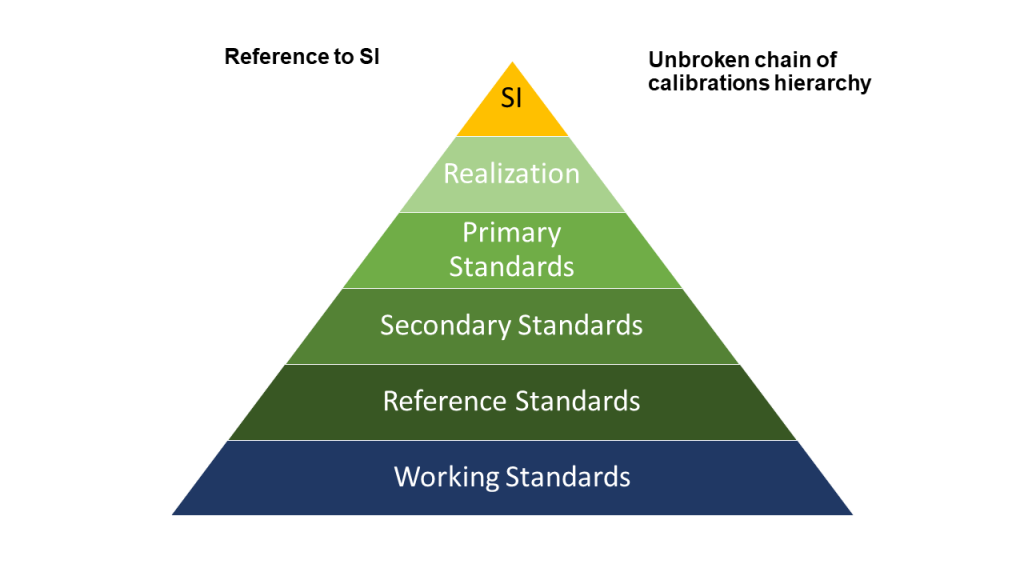
How the traceability of calibrations works:
- SI Unit: The SI unit, also known as the International System of Units (SI), is the modern, internationally accepted system of measurement used in science, engineering, commerce, and everyday life. It provides a consistent and coherent framework for measuring physical quantities. The SI system was developed and is maintained by the International Bureau of Weights and Measures (BIPM) in France. The SI system is based on seven base units, from which twenty-two other units are derived.
- Primary Standard: Primary standards are an established and unambiguous reference for a specific quantity. These primary standards are maintained by National Metrology Institutes (NMIs) or other internationally recognized organizations and are traceable to SI Units.
- Secondary Standard: Secondary standards are calibrated using the primary standard, and they serve as references for other measuring instruments. These may be maintained at regional or institutional calibration laboratories.
- Reference Standards: Reference Standards involve comparing a measuring instrument’s output to a secondary standard. The comparison process determines any deviations or errors in the reference standards measurements.
- Working Standards: Working Standards, also known as working reference standards, are instruments or artifacts used in the calibration process to verify or adjust the accuracy and precision of other measuring instruments or devices. These standards serve as intermediaries between primary reference standards (maintained by national metrology institutes) and the instruments used in everyday measurements.
- Certificate of Calibration: The certificate of calibration establishes the traceability chain, showing how the measuring instrument’s readings are linked to the SI Unit through a series of unbroken comparisons.
The importance of calibration traceability lies in its ability to provide confidence in the accuracy of measurements and the reliability of data. In scientific research, engineering, manufacturing, and other fields where precise measurements are critical, having a clear traceability chain ensures that the measurements are consistent and comparable across different locations and time periods.
Traceability is essential for maintaining quality standards, complying with regulations, and ensuring the integrity of products and processes that rely on accurate measurements. It is a crucial aspect of metrology and underpins much of modern science, technology, and industry.
Traceability Definitions
Traceability Chain:
A “sequence of measurement standards and calibrations that is used to relate a measurement result to a stated reference.” ISO/IEC Guide 99:2007 – International Vocabulary of Metrology (VIM)The “property of a measurement result whereby the result can be related to a reference through a documented unbroken chain of calibrations, each contributing to the measurement uncertainty“ (VIM-International Vocabulary of Metrology)
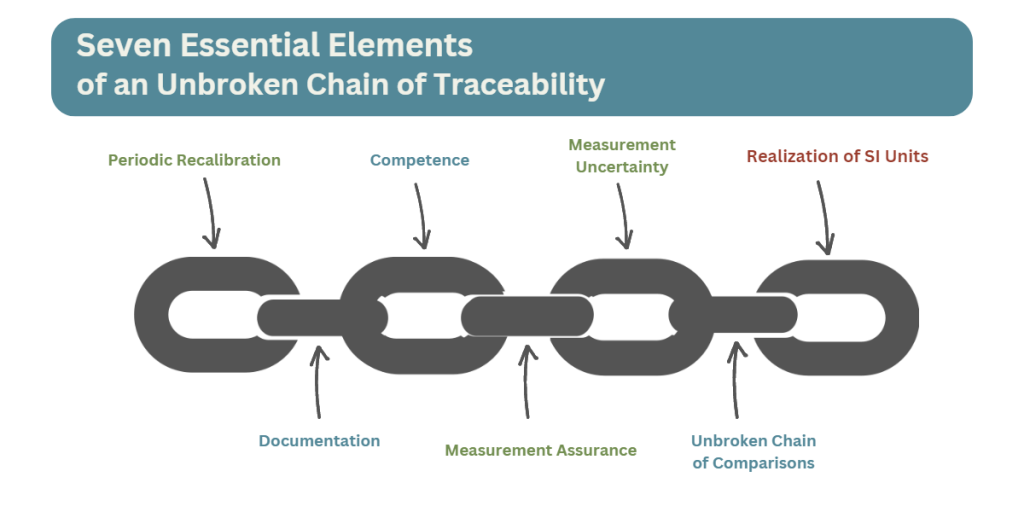
Metrological Traceability
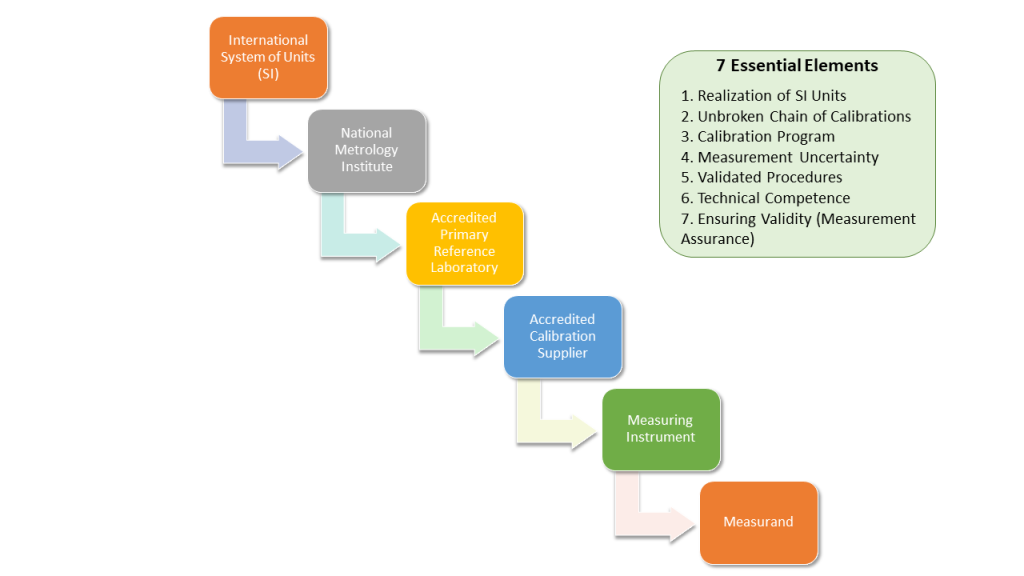
Metrological traceability refers to the ability to trace a measurement result or a calibration result back to a standard that is internationally recognized and accepted. It is an essential element in ensuring the accuracy and reliability of measurement results. Metrological traceability is achieved by establishing an unbroken chain of comparisons, each step of which is documented, linking a measurement result to a reference standard. The reference standards used for metrological traceability are usually maintained or established by national metrology institutes or other metrology organizations. By ensuring metrological traceability, one can have confidence in the accuracy of measured values and can compare results obtained from different measurements or laboratories. As a result, metrological traceability is critical in many fields, including science, medicine, engineering, and industry.
“Metrological traceability requires the establishment of an unbroken chain of calibrations to specified reference standards: typically, national or international standards, in particular realizations of the measurement units of the International System of Units (SI).” (NIST Policy on Metrological Traceability)
References
- International vocabulary of metrology – Basic and general concepts and associated terms (VIM) 3rd edition, Retrieved from: https://www.bipm.org/documents/20126/2071204/JCGM_200_2012.pdf
- NIST Technical Note 2156, Metrological Traceability, Retrieved from: https://www.nist.gov/publications/metrological-traceability-frequently-asked-questions-and-nist-policy
- NIST Special Publication 2200, Legal Metrology Publication Series, Retrieved from https://www.nist.gov/pml/owm/legal-metrology-publication-series-sp-2200