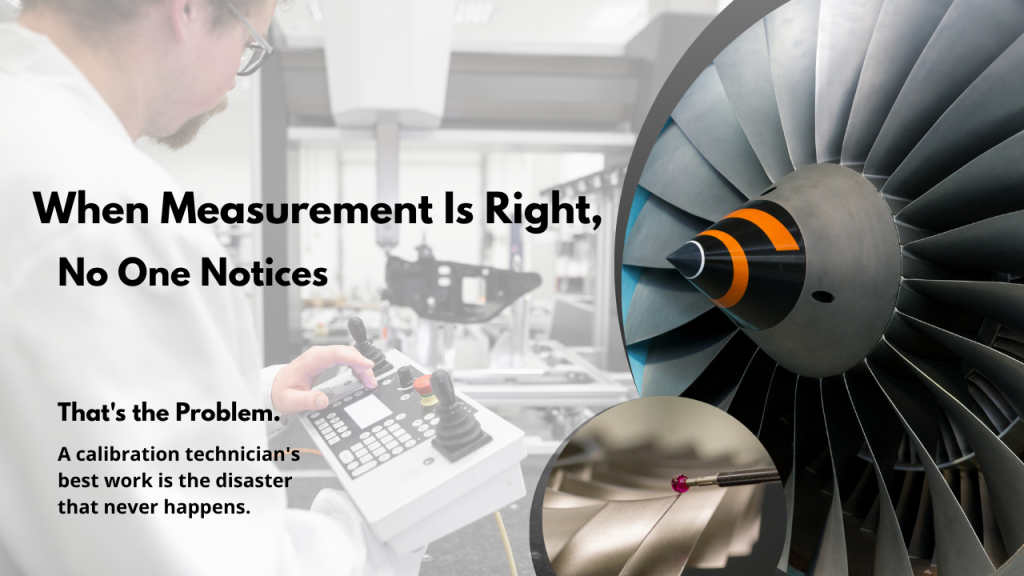
When Measurement Is Right, No One Notices.
That’s the Problem.
A calibration technician’s best work is the disaster that never happens. America is running short of the people who do that work — and the fix starts with making an invisible trade visible, early and everywhere.
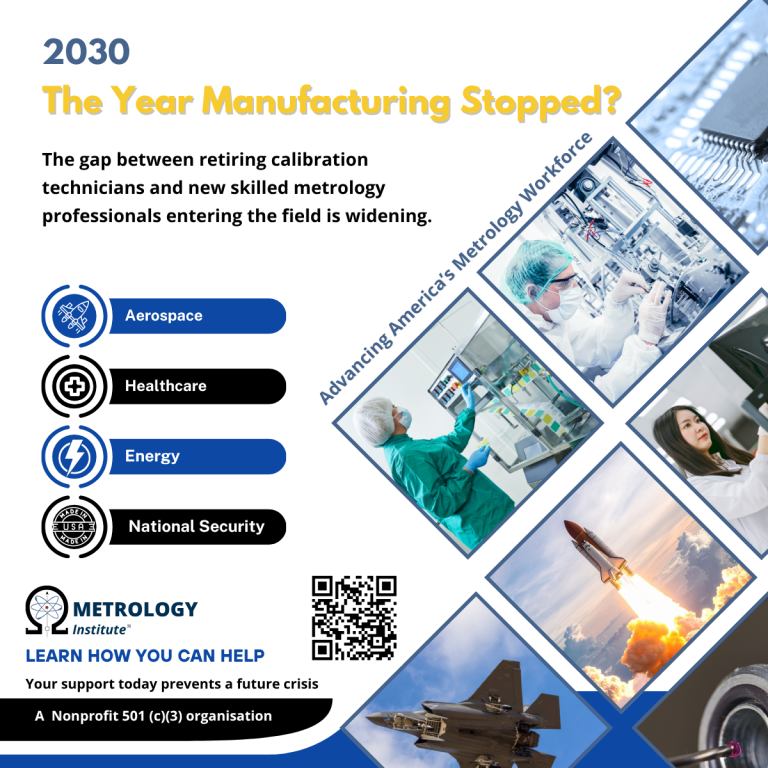
Ask most Americans to name the skilled trades, and they will list electricians, welders, machinists, and plumbers. Few will mention the calibration technician, yet the profession occupies the same territory: hands-on technical work, rigorous credentialing, direct consequences for public safety, and strong wages without requiring a four-year degree. The U.S. Bureau of Labor Statistics formally recognizes the occupation Calibration Technologists and Technicians, SOC code 17-3028, reporting a median wage of $65,040 per year and projecting 6 percent employment growth through 2033, faster than the average across all occupations. Every safe flight, sterile surgical instrument, accurate diagnostic test, and defect-free microchip depends on this workforce. Yet roughly 60 percent of advanced manufacturers report difficulty finding qualified calibration technicians, and 72 percent of employers describe existing training programs as inadequate, fragmented, or outdated.
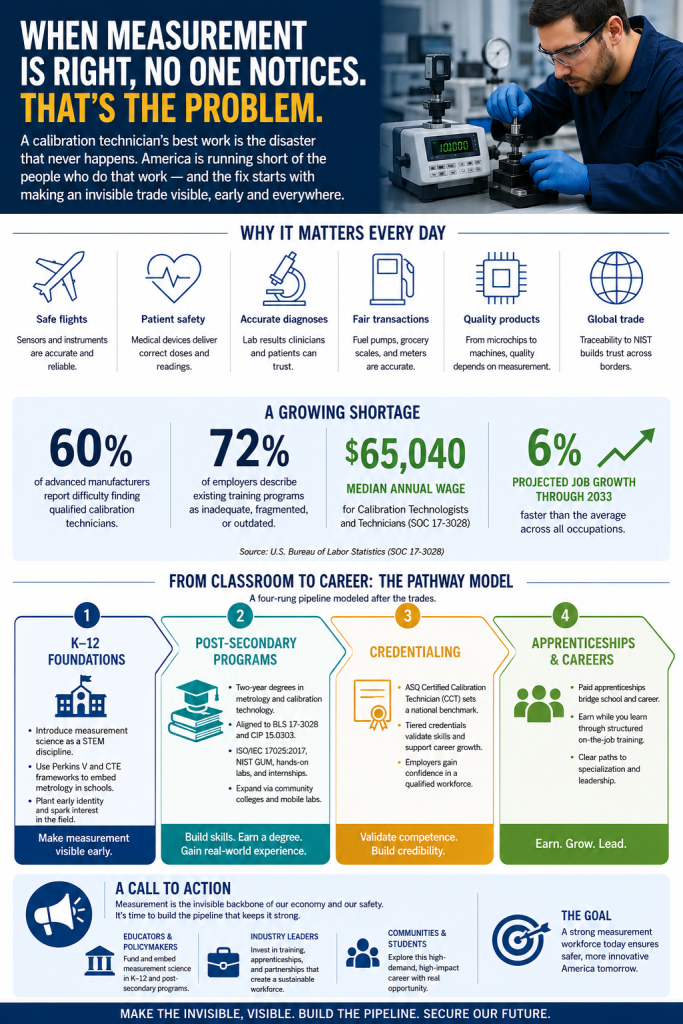
The reach of this work is easy to underestimate. The International System of Units (SI) provides the common measurement language that makes global trade possible: a kilogram, a meter, and a volt mean the same thing in Chicago as in Frankfurt or Osaka, and internationally recognized traceability to National Metrology Institutes (NMI) such as NIST is what allows an American manufacturer’s products to be accepted in foreign markets without retesting at every border. Closer to home, measurement science quietly shapes daily life: the dose delivered by an infusion pump, the accuracy of a blood-pressure reading, the fuel dispensed at the filling station, the weight printed on a grocery scale, the sensors guiding an aircraft safely to the runway. When measurement is right, no one notices. That invisibility is precisely the profession’s recruiting problem.
The shortage is real, but it is a symptom. The underlying condition is that America has never built a career pathway into measurement science, and pathways, like the trades themselves, must be constructed delibeThe reach of this work is easy to underestimate. The International System of Units (SI) provides the common measurement language that makes global trade possible: a kilogram, a meter, and a volt mean the same thing in Chicago as in Frankfurt or Osaka, and internationally recognized traceability to National Metrology Institutes (NMI) such as NIST is what allows an American manufacturer’s products to be accepted in foreign markets without retesting at every border. Closer to home, measurement science quietly shapes daily life: the dose delivered by an infusion pump, the accuracy of a blood-pressure reading, the fuel dispensed at the filling station, the weight printed on a grocery scale, the sensors guiding an aircraft safely to the runway. When measurement is right, no one notices. That invisibility is precisely the profession’s recruiting problem.
The shortage is real, but it is a symptom. The underlying condition is that America has never built a career pathway into measurement science, and pathways, like the trades themselves, must be constructed deliberately, starting early.rately, starting early.
The 24/7 Mentor: AI-Powered Metrology Education
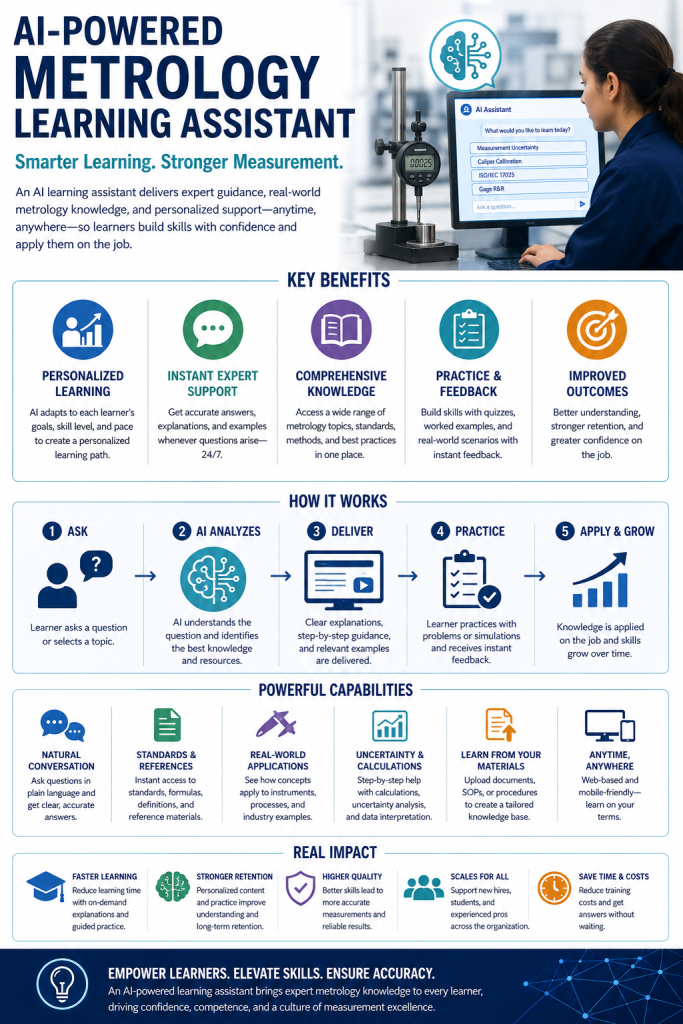
Every rung of that ladder shares one constraint: expert instruction is scarce. The same shortage that leaves laboratory benches unstaffed leaves classrooms without qualified metrology instructors. A rural community college cannot hire a seasoned metrologist for every evening section; a transitioning veteran studying for the CCT exam cannot schedule questions for business hours; a second-career learner working days needs answers at midnight. Historically, expertise in measurement science has lived where the experts live inside well-staffed corporate and government laboratories and nowhere else.
This is the problem the AI-powered metrology assistant is beginning to solve, and it is why the technology matters most as an educational instrument rather than a laboratory convenience. Unlike general-purpose AI chatbots, which can fabricate standard clause numbers and misstate requirements an unacceptable hazard in a discipline built on traceability a domain-specific metrology assistant is grounded in the field’s authoritative references: ISO/IEC 17025:2017, the GUM and its supplements, NCSLI™ Recommended Practices, and accreditation guidance from bodies such as A2LA™. Its answers cite sources a learner can verify, modeling the evidence-based habit of mind the profession demands from day one.
MetTutor, developed by professionals within the metrology community, illustrates what this category makes possible. Rather than serving a single audience, such platforms meet learners wherever they stand in their careers: the student preparing for professional certification, the technician strengthening uncertainty analysis skills, the engineer interpreting a standards requirement, with structured instruction in calibration fundamentals and measurement methodology spanning the discipline’s full breadth: dimensional, electrical, temperature, pressure, mass, force, and beyond. Because the platform never closes, an AI-powered metrology assistant like MetTutor functions as the always-available mentor the field has never had, delivering individualized instruction at a scale and schedule no human faculty could match. That is what accessible education means in practice: the learner in a town with no metrology program, studying at 11 p.m., receives the same standards-anchored guidance as the technician inside a Fortune 500 calibration laboratory.
None of this displaces hands-on training. Calibration is bench work, and no software substitutes for supervised time with gauge blocks, decade boxes, and pressure standards. What the technology changes is everything around the bench: the concepts, the calculations, the standards interpretation, and the exam preparation that once gated entry to those who happened to live near expertise.
A Shared Responsibility
No single institution can build a pipeline alone. Federal and state governments can fund a national metrology workforce program through NIST, the Department of Labor, and the Department of Education, and embed measurement science in STEM and CTE frameworks. Industry can co-develop certification standards, sponsor apprenticeships, and donate equipment to school programs. Educational institutions can adopt NIST-aligned curricula and build dual-credit bridges from high schools. Professional societies, ASQ™, NCSLI™, and the accreditation community can continue strengthening the credentials that give the trade its backbone. The goal advanced by workforce advocates training and credentialing 10,000 metrology professionals by 2030 is modest against the industries at stake, and achievable only if the pathway begins in the classroom.
Measurement as a National Priority
America’s competitiveness in high-technology manufacturing rests on its ability to measure with precision, and that ability rests on people. The calibration technician is already a skilled tradesperson in every substantive sense: in rigor, in consequence, in craft. Making it official requires the same investments the traditional trades received: early exposure, visible pathways, portable credentials, and instruction accessible to anyone with the aptitude, anywhere, at any hour. The science of measurement advances one well-taught learner at a time. It is time we taught them earlier, and never turned off the lights.